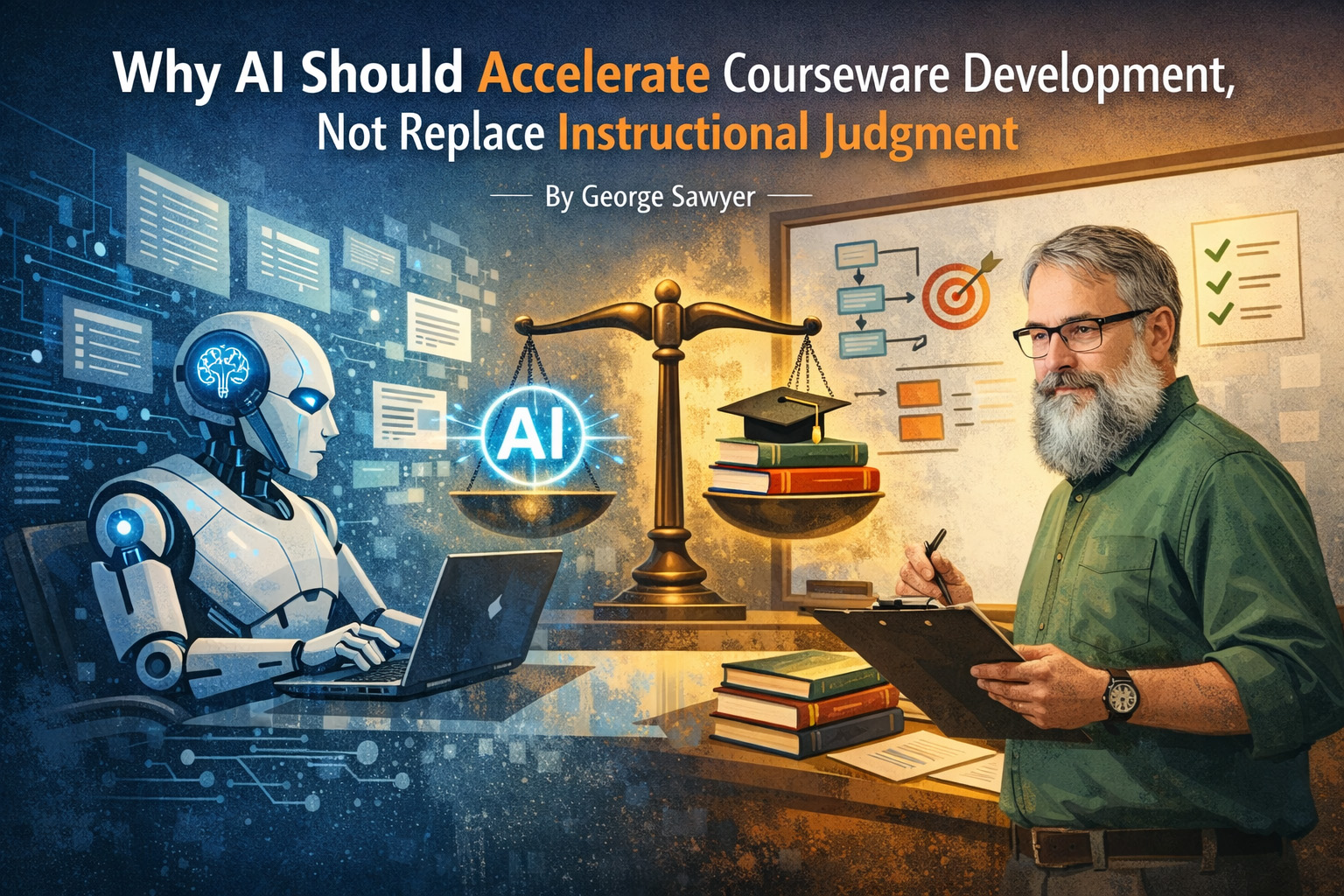
There is a lot of excitement right now about using AI in courseware development. Some of that excitement is justified. AI can reduce development time, speed production, and make it more realistic to build richer learning experiences than many teams could have afforded to create entirely by hand.
But there is a dangerous idea hidden inside some of the enthusiasm: the idea that AI can replace the judgment of an experienced educator.
It cannot.
In technical education especially, the value is not in producing words quickly. The value is in deciding what matters, what is accurate, what is relevant to the learner, what should be assessed, what can be trusted, and what must be corrected before it reaches a classroom. AI can help with production. It does not remove the need for authorship.
That distinction matters.
- Speed Is Valuable, but Speed Is Not Quality
- Technical Training Has a Rigor Problem, Not Just a Speed Problem
- The Author Is Still the Author
- What AI Is Actually Good at in Courseware Development
- Where AI Still Needs Expert Oversight
- AI Should Raise the Floor and the Ceiling
- A Better Model: AI-Assisted, Expert-Led
- The Future Belongs to Educators Who Use AI Well
Speed Is Valuable, but Speed Is Not Quality
One of the biggest constraints in technical courseware development has always been time. High-quality courses require more than a slide deck and a lab guide. They need aligned learning objectives, coherent explanations, hands-on practice, assessments, reinforcement, instructor support, and a learning flow that makes sense to real students.
That rigor takes time. It also takes money. In many organizations, those pressures lead to familiar compromises: a rushed deck, a thin guide, maybe a lab or two, and the hope that a strong instructor can compensate for what was never fully built.
AI changes that equation.
Used well, AI can help generate initial structures, propose outlines, draft assessment items, create practice activities, build first-pass study aids, and accelerate repetitive development tasks. That is a real gain. It means authors can spend less time staring at a blank page and more time reviewing, refining, validating, and improving.
That is where the value is.
AI is most useful when it reduces low-value friction and creates more room for high-value educational judgment.
Technical Training Has a Rigor Problem, Not Just a Speed Problem
The conversation around AI in learning often focuses too narrowly on productivity. The bigger issue in technical education is that too much content is still built around delivery instead of learning.
We often ask, "Did we cover the material?" when we should be asking, "Did learners actually gain the intended capability?"
Those are not the same question.
A course can be well presented and still fail to produce competence. A polished deck can still leave students unable to perform. A hands-on lab can still be poorly sequenced, weakly validated, or disconnected from the real objective.
This is where instructional judgment matters most. Someone has to decide:
-
what the learner should be able to do at the end
-
what evidence would show that learning happened
-
what misconceptions are likely to appear
-
where reinforcement is needed
-
whether the lab works in real conditions
-
whether an assessment measures understanding rather than guesswork
AI does not own those decisions. An educator does.
The Author Is Still the Author
When I use AI in courseware development, I do not think of it as handing over the work. I think of it as accelerating the framework so I can invest more energy where human expertise matters most.
That means I still review for technical accuracy. I still verify that examples are appropriate. I still correct nuance. I still tune the pacing. I still decide whether an explanation will make sense to the intended audience. I still reject content that sounds plausible but teaches the wrong mental model.
In other words, I am still the author.
That is the mindset I believe technical educators need to keep. AI can help us build faster, but it does not remove our responsibility for the quality of the final learning experience. If anything, it increases that responsibility, because generated content can look polished long before it is truly ready.
A confident tone is not the same thing as sound instruction.
What AI Is Actually Good at in Courseware Development
The most effective use of AI in learning design is not to ask it to "make a course" and walk away. It is to use it in targeted ways that support a disciplined development process.
In my experience, AI is especially useful in five areas.
Rapid Framework Generation
AI is excellent at helping create a first-pass structure. It can accelerate outlines, module decomposition, draft learning objectives, lesson flow ideas, assessment blueprints, and topic sequencing proposals. That gives the author something to react to quickly.
Content Expansion
Once the structure is sound, AI can help expand examples, create alternate explanations, draft summaries, produce scenario ideas, and generate candidate quiz items or knowledge checks.
Variation and Reinforcement
One of the hardest things to justify in traditional budgets is building the value-adds that actually help learners: extra practice, flash cards, reference sheets, multiple quizzes, detailed explanations, remediation prompts, and alternate lab pathways. AI makes these supporting assets more realistic to produce.
Development Support for Labs
AI can help draft setup scripts, validation steps, cleanup scripts, troubleshooting notes, and challenge variations. That matters in technical training, where a broken lab can waste classroom time and destroy learner confidence.
Instructor Enablement
AI can help generate first-pass instructor notes, teaching prompts, timing suggestions, discussion questions, and explanation variants. This is not glamorous work, but it is essential if training is going to scale well.
These are meaningful advantages. They improve both speed and completeness.
But none of them eliminate the need for expert review.
Where AI Still Needs Expert Oversight
AI-generated learning content tends to fail in ways that are especially risky in technical education.
It may be factually wrong in subtle ways. It may overstate certainty. It may mix beginner and advanced assumptions in the same lesson. It may produce assessment questions that reward pattern matching instead of understanding. It may create labs that sound plausible but do not actually run. It may generate explanations that are grammatically smooth yet conceptually misleading.
This is why educational quality cannot be outsourced to generation.
A good educator does more than spot errors. A good educator evaluates whether the whole learning system makes sense. Does the course build from foundational to applied skill? Do assessments align with objectives? Do labs reinforce the intended concepts? Are learners being set up for success, or just being exposed to information?
That kind of review is not cosmetic. It is the work.
AI Should Raise the Floor and the Ceiling
The best argument for AI in technical education is not that it makes content cheaper. It is that it makes better learning packages more achievable.
Used well, AI can raise the floor by helping teams avoid the bare-minimum course kit. It can also raise the ceiling by making it practical to include items that too often get cut from scope: pre-assessments, post-assessments, detailed quiz explanations, practice exams, reference tools, validated labs, and instructor support materials.
That matters because learners do not benefit most from more words. They benefit from better-designed learning experiences.
The promise of AI is not just faster output. The promise is that we can now afford to build more complete educational systems around the learner.
That is a much more important goal.
A Better Model: AI-Assisted, Expert-Led
The model I believe in is simple: AI assists. Experts lead.
That means using AI to accelerate structure, reduce repetitive drafting, and expand the range of supporting materials. It also means preserving the role of the educator as the person accountable for coherence, correctness, relevance, and rigor.
In practical terms, that looks like this:
-
AI helps generate the first pass.
-
The author audits for technical accuracy.
-
The educator aligns content to objectives.
-
Assessments are reviewed for validity.
-
Labs are tested and revised.
-
Supporting materials are added deliberately.
-
The final product is judged by learner outcomes, not by how quickly it was produced.
This is not anti-AI. It is pro-quality.
The Future Belongs to Educators Who Use AI Well
I do not believe AI will eliminate strong technical educators. I believe it will increase the gap between weak courseware and strong courseware.
Teams that use AI carelessly will produce more content, faster, with many of the same flaws they had before — and possibly worse ones.
Teams that use AI well will produce better learning systems: more complete, more measurable, more adaptable, and more supportive of both learners and instructors.
That is the opportunity.
The question is not whether AI should be used in courseware development. It already is, and it should be. The real question is whether we will use it to replace educational judgment or to amplify it.
For those of us who care about rigor, measurable learning, and real learner success, the answer should be clear.
AI should accelerate courseware development.
It should never replace instructional judgment.
This is one of the core questions shaping both my work at Learn Flourish and the development of Trellis.